Long Term Planning and Organization of On/Off-Field Loading in Professional Football
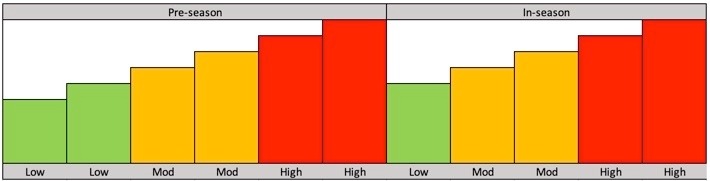
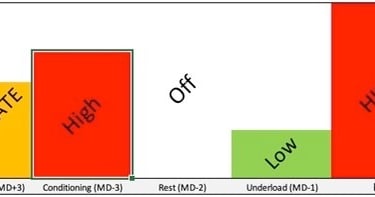
The training process is essential for physically preparing players for peak match demands and reducing injury risk. An effective training process is planned, navigates increased fixture congestions, and anticipates player recovery duration. To ensure effective training process can be designed fundamental rules should be followed across the performance and sport science department when designing the long-term plan. The key rules that must be followed is that the training load should be normalised long-term, diversified short-term, and aligned day-to-day. What this means is that although there should be variation across training load from week-to-week, it is critical that changes in load are gradual to keep players healthy so they can continue to adapt to the training stimulus. Additionally, training prescription across both the field and the weight room should complement one another to ensure that there no roadblocks as far as adaptation goes.
The technical staff rely on the performance coach to guide decision making about training load to help keep players healthy. It is critical for organisations to be proactive in injury preventions due to the significant impact injuries have shown to have on team success (Drew et al., 2017). Not only have injuries shown to effect team performance but there are also considerable financial implications associated with injury burden. Currently injury incidences are still occurring more so during match play as opposed to training (Xie & Cai, 2026). This suggests that either training load is not sufficient to help players adapt to the peak demands of the sport or that the training load is excessive and the players have not recovered sufficiently prior to match play. Performance coaches must intelligently navigate their way through this paradox by normalising training load within individual thresholds. In a paper by Gabbett (2016), showed that there was an increase in injury risk when there were increases of greater than 10% in training load. While there was no consideration for individual physical capacity or physiological monitoring of the players who were involved in this study, practitioners should plan for gradual increases of training load and be mindful of increases greater than 10%. In addition to increasing training load, practitioners should also plan on decreasing the training load so that athletes can recover sufficiently. It is during these underload periods that players will adapt to the previous block of training. This allows them to engage in the next block of training with a greater physical capacity.
Once the long-term training plan has been established, it is now important to identify how each training day will be used from a physical standpoint. As far physical stimulus goes a team sport such as football is incredibly mixed. For instance, moments of match play can vary from trapping the opposing team in a small space and pressing or running at top speeds during a full field transition. The question is not which of these peak demands should we train this week, but what training day can we prepare for these respective match demands? The solution covering a wide array of physical stimuli during the training week is diversifying the key physical output.
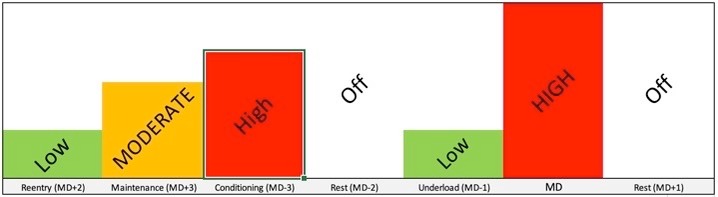
This means that whatever the physical target is on a MD-4 it will not be the target on MD-3. For example, in a paper by Stevens (2017), the most amount of moderate and high-intensity decelerations occurred in the MD-4 session which is common in a training design that possesses a significant volume of small-sided games (SSG). However, the MD-3 session had much more high-speed running action which is normal to see in sessions with large-sided games (LSG) or full field matches. Diversifying the training load day-to-day is crucial for covering a broad basis of physical stimuli across an entire training week. Variability in training load will prevent similar types of fatigue, whether muscular or neuromuscular, being targeted consecutively and will allow for sufficient recovery.
It is the on-field training prescription that sets the precedent for all other training stimulus. Other training prescription such as speed development, conditioning, and strength training are viewed as supplementary to the primary training stimulus. It is not that these aspects of training are not valued, it is just that the amount of training completed within the session content is valued based on its translation to the technical and tactical components and the physiological cost. Therefore, it is essential that the supplementary training modalities are aligned with the on-field training content so that the intended training target is met. It is common practice for football players to cover the greatest amount of high-speed running and sprint distance on a MD-3 training day compared to other training days. This means there would be an expected increase in neuromuscular fatigue because of that training stimulus (Thorpe et al., 2017). Since sessions with considerable high-speed running and sprint distance have a prolonged recovery window, it makes the most sense to prescribe similar training stimuli during the MD -3 training session. For instance, maximal speed work is critical in improving top end speed and is essential for reducing hamstring injury risk (Gómez-Piqueras & Alcaraz, 2024). If this was prescribed on a training day prior to the MD-3 session the neuromuscular fatigue that derived from that stimulus would distract from the training target. Conversely, if the maximal sprint efforts were to be prescribed following the MD-3 it is likely fatigue and soreness would prevent a sufficient maximal sprint speed to be achieved. Additionally, the MD -3 training session creates a substantial muscular stress of the hamstring tissue. When aligning the training prescription, the preferred supplementary strength training stimuli would target the hamstrings. This means that from a tissue and neuromuscular standpoint, the players will have 72-hour window of recovery before the match.
The training process is complex, if details are overlooked injuries or a lack of match fitness could negatively impact performance. The training process is essential in preparing players for the peak match demands and reducing the risk of injury. To ensure that planning is consistent there are three key steps that must be followed. It is that the training load should be normalised long-term, diversified short-term, and aligned day-to-day. These three steps refer to the gradual increases in training load, load variance, and session alignment.
Citations
Drew, M. K., Raysmith, B. P., & Charlton, P. C. (2017). Injuries impair the chance of successful performance by Sportspeople: A Systematic Review. British Journal of Sports Medicine, 51(16), 1209–1214. https://doi.org/10.1136/bjsports-2016-096731
Gabbett, T. J. (2016). The training—injury prevention paradox: Should athletes be training smarterandharder? British Journal of Sports Medicine, 50(5), 273–280. https://doi.org/10.1136/bjsports-2015-095788
Gómez-Piqueras, P., & Alcaraz, P. E. (2024). If you want to prevent hamstring injuries in soccer, Run fast: A narrative review about practical considerations of Sprint training. Sports, 12(5), 134. https://doi.org/10.3390/sports12050134
Stevens, T. G., de Ruiter, C. J., Twisk, J. W., Savelsbergh, G. J., & Beek, P. J. (2017). Quantification of in-season training load relative to match load in professional Dutch Eredivisie football players. Science and Medicine in Football, 1(2), 117–125. https://doi.org/10.1080/24733938.2017.1282163
Thorpe, R. T., Strudwick, A. J., Buchheit, M., Atkinson, G., Drust, B., & Gregson, W. (2017). The influence of changes in acute training load on daily sensitivity of morning-measured fatigue variables in elite soccer players. International Journal of Sports Physiology and Performance, 12(s2). https://doi.org/10.1123/ijspp.2016-0433
Xie, Y., & Cai, X. (2026). High-speed running and injury risk in soccer: A systematic review. Frontiers in Public Health, 14. https://doi.org/10.3389/fpubh.2026.1798241

info
Visit Us
Contact Us
+17176097677
arrowmovementaca@gmail.com